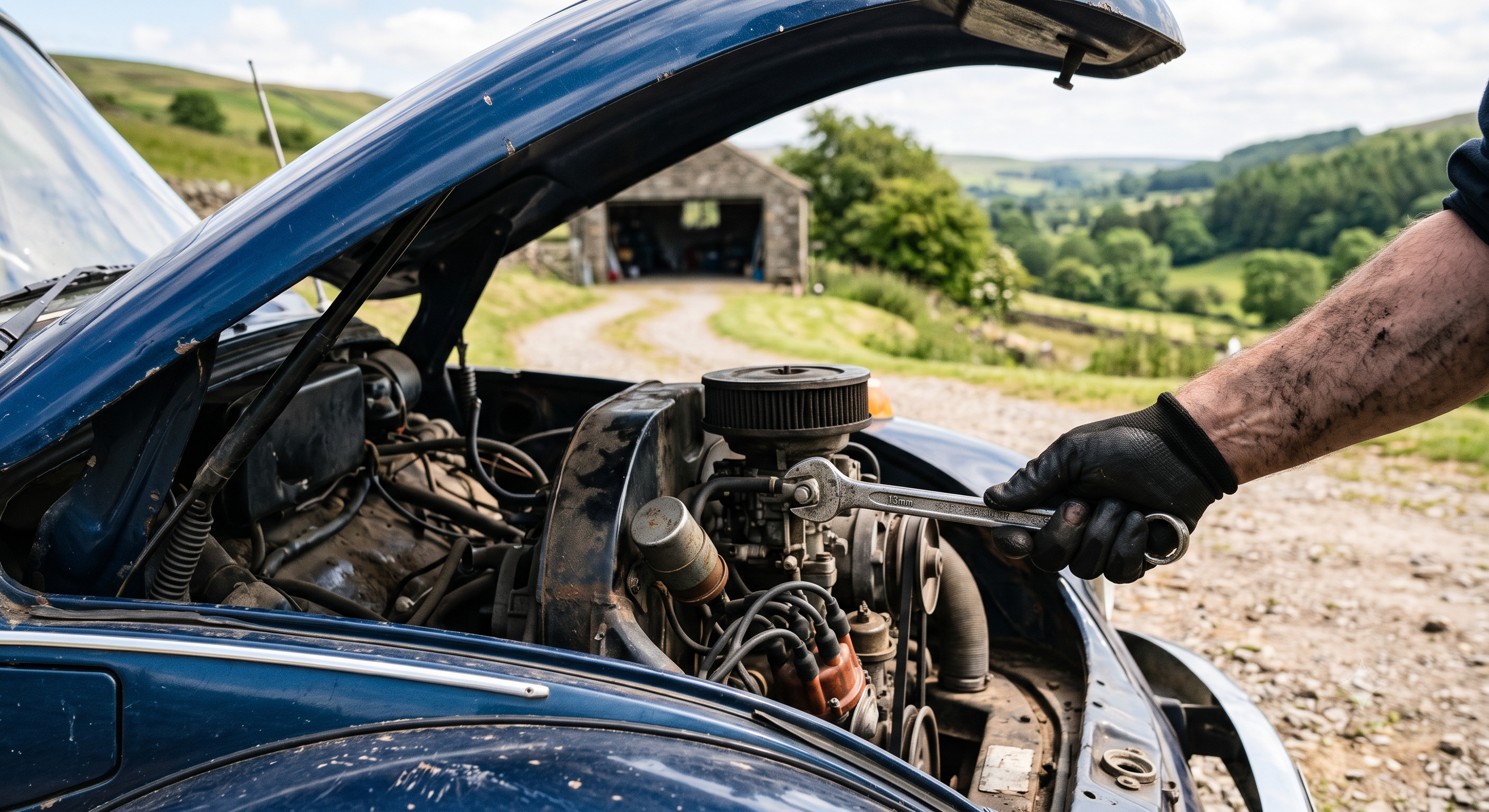
Everyone knows what a spanner is. Everyone knows what a car is. And there’s a very important gap: when the car coughs, splutters and dies at the roadside, how many people know which spanner to reach for, where it goes, and at what point in the repair? That's the whole thing. The difference between someone who can hold a spanner and someone who can fix an engine isn't determined by ownership of the tool. It's knowing which tool to use, where, and when.
AI is a spanner. A remarkable, intimidating and energy-intensive one for sure, and a good deal lighter than the sturdy chrome thing that lives in a box in the boot. But the same logic applies with an uncomfortable precision. Having access to the tool tells you nothing about whether the person wielding it can actually fix the car. We've handed the entire population a gleaming toolbox and somehow concluded that everyone is now a mechanic.
They are most certainly not. And that difference is now the most valuable thing in marketing.
Think about what actually lives in a good mechanic's head. Not just the tools, but the sequence. The diagnosis before the repair. The knowledge that you loosen this before you touch that, that the obvious fix is sometimes the wrong one, that the noise the engine is making points to a problem two systems away from where it sounds. None of that lives in the spanner. It lives in the years of opening up engines and (in the early days at least) getting it wrong much of the time. The access to the tool is the easy part and it always was.
This is where most organisations are asking the wrong question. I know a marketer whose boss opens every copy review with the same line: "Did you use AI to write this?" He thinks he's protecting standards. But he's revealing that he's misunderstood the entire thing.
It's the equivalent of a creative director squinting at a layout and demanding to know whether the designer used Illustrator, InDesign or Photoshop — or all three. Well…of course they did!
What did you imagine they used? The tool isn't the question. And the use of it is simply assumed, the way we assume a writer used a keyboard rather than chiselling the copy into stone. Asking whether the tool was used is a category error dressed up as diligence.
The only question worth asking is where the human entered the loop. Because that, and not the tool, is where quality is ultimately decided.
Here is the part that the "did you use AI" crowd keeps missing. It doesn’t actually matter very much what the tool produces in its first pass. The draft, the option, the raw output — that's the engine running but still rattling and belching some unfamiliar smoke from the exhaust. The critical moment, the one that separates forgettable work from work worth putting your name to, is when an experienced human takes that output and reviews it, interrogates it, cuts the parts that are merely competent, and refines what's left into something with an actual point of view. That moment requires judgement the tool doesn’t have and cannot fake. It requires knowing what good looks like, which is a thing you earn through experience and not a thing you can merely prompt.
So I don't much care whether someone on my team or anywhere else used AI. I'd be faintly suspicious if they hadn't, the same way I'd wonder about a designer who insisted on doing everything by hand to prove a point. What I care about is what they did after the tool stopped.
Did they bring taste to it? Did they know which parts to keep and which to throw away? Did they enter the loop at the right moment, with the right standard, and make it better?
That's the toolbox that matters. Not the one you can spend small or large amounts of money on. It’s the one you build by spending many oil-smeared and sweat-soaked years under the bonnet, learning where the spanner goes.
These days anyone can hold the tool. But knowing exactly what to do with it is still rare. It always was.